In the Summer of 2023, I worked with two other students to investigate how urbanization effects the migratory bird populations in the city of Atlanta. We started out with information we already knew, like how historical redlineing effects new urban developments today.
Redlining is the discriminatory practice of dividing neighborhoods based on race. Even though this practice was outlawed in the 1960s, the practice caused many neighborhoods today to be deemed desirable or undesirable (Federal Reserve History. “Redlining.”). Because of this, certain neighborhoods can be more effected by extreme heat and deforestation than others.
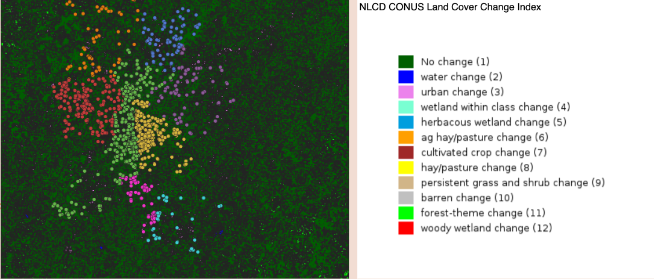
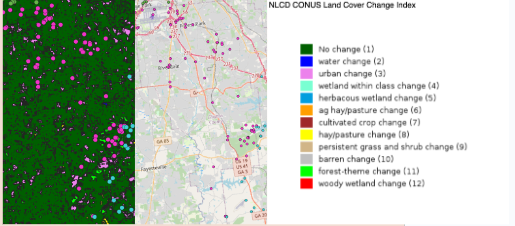
To find out if our hypothesis of that bird biodiversity was effected by urban change, we used ebird data and CONUS Land Use data over the last twenty years and layered them in QGIS. We also utilized R and other data programs to examine the relationship between the land change index and the biodiversity using Shannon’s Diversity Index and Species Richness Index.
Our findings showed that the bird biodiversity was effected by urban change. Counties in urban Atlanta with little or no change showed more species richness than in areas with urban change.
The only exception to this was in Clayton county and Cherokee county. In Clayton county an artificial wetland was constructed within this twenty year time period.
It is currently unknown what happened in Cherokee county that positively effected bird biodiversity.
We hope to bring this research further to look at bird populations in other south-eastern urban areas to see if we find similar results. Perhaps city planning can implement artificial and reconstructed environments to accommodate with the drop in biodiversity that comes with urbanization.
This research was funded by the STEM Scholar’s Program at Agnes Scott College, The Frances Marx Shillinglaw Women in Science Endowed Fund, and the The Sherman Fairchild Foundation Summer Stipend Program. This research was performed under Dr. Jennifer Kovacs as part of the STEM Scholar’s Program summer of 2023.
Works Cited:
Federal Reserve History. Redlining. June 2nd, 2023. Accessed January 28th 2024. https://www.federalreservehistory.org/essays/redlining
Simkin, Rohan, et al. Biodiversity Impacts and Conservation Implications of Urban Land Expansion Projected to 2050 | PNAS March 14th 2022 https://www.pnas.org/doi/10.1073/pnas.2117297119. Accessed 23 July 2023.
Case Study: The Clayton County Constructed Wetlands. Sewanee Wetlands, http://sewaneewetlands.org/case-study-the-clayton-county-constructed-wetlands. Accessed 23 July 2023.
Jung, Martin, et al. Impacts of Past Abrupt Land Change on Local Biodiversity Globally. Nature Communications, vol. 10, no. 1, 1, Dec. 2019, p. 5474. www.nature.com, https://doi.org/10.1038/s41467-019-13452-3 Accessed 23 July 2023

Leave a Reply